Sets Per Muscle Per Week: Start Lower Than Social Media Suggests
Weekly set targets are planning ranges, not entry fees. Count challenging work honestly, begin with a recoverable dose, and add only when progress asks for it.
By Moow Editorial ·
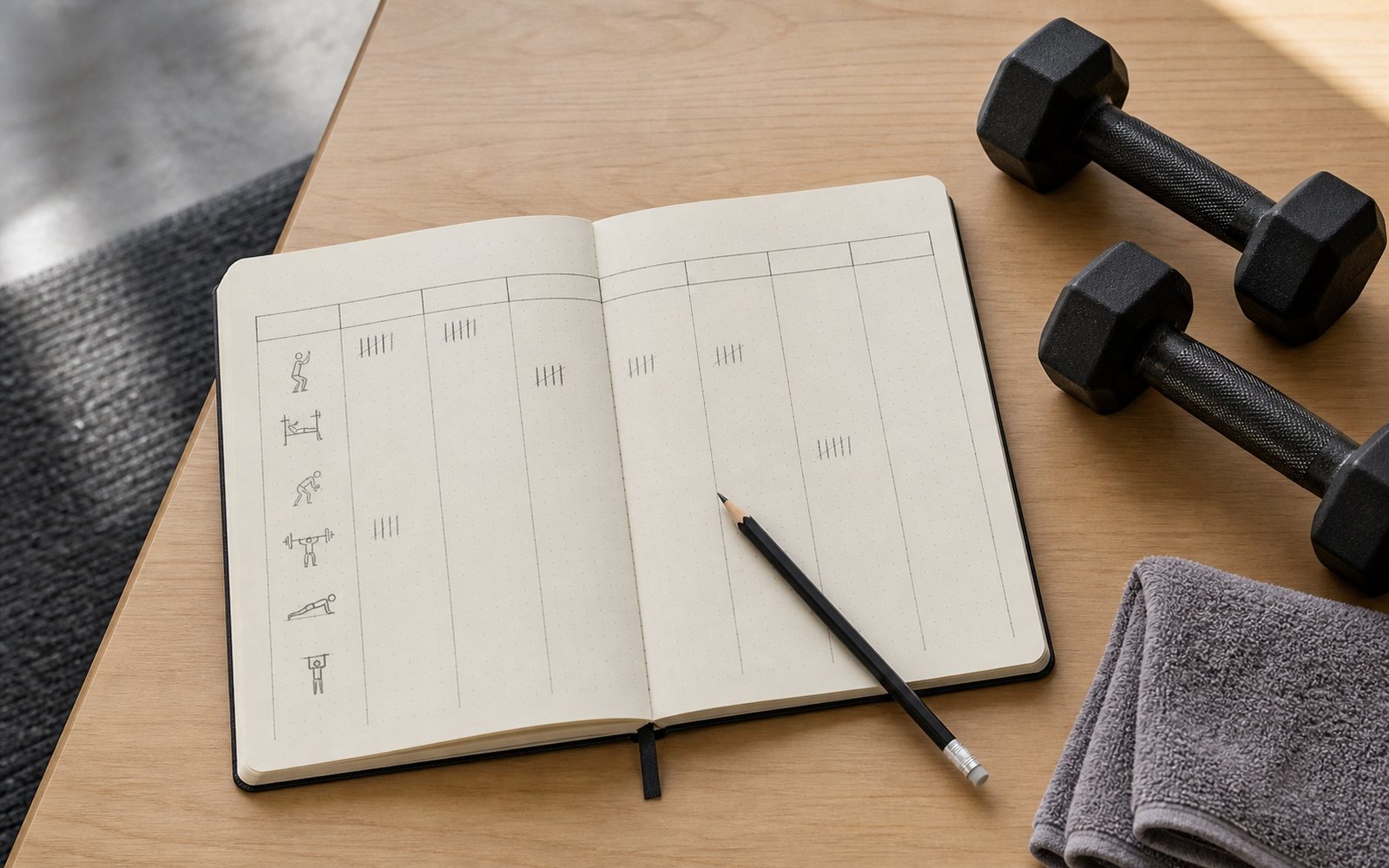
- Count challenging direct sets, not every warm-up and movement that mentions a muscle.
- Begin with a volume you can recover from and repeat across several weeks.
- Add sets only after technique, effort, sleep, and nutrition are reasonably consistent.
Understand what the number counts
A weekly set target usually refers to challenging working sets for a muscle group, not warm-ups or every activity that uses the muscle at all. A bench press clearly trains the chest and also involves triceps and shoulders; whether you count it fully for every muscle depends on the planning method. False precision is less useful than using the same reasonable system over time.
Health-oriented resistance training does not require bodybuilding-level volume. Training the major muscle groups at least twice weekly is a strong basic target, and even modest programs can improve strength and function. Higher volume can support muscle growth, but it also demands more session time and recovery. The maximum amount you can survive is not the minimum amount required.
A set count is a bookkeeping tool, not a score for how seriously you train.
Find a recoverable starting volume
If you are new, begin with two or three full-body sessions and a small number of hard sets per movement pattern. Two sets of a squat, push, pull, and hip-dominant exercise repeated twice weekly already create meaningful practice. Keep several repetitions in reserve while technique develops. You can build from there rather than opening at an advanced template's ceiling.
For a muscle-gain emphasis, roughly ten weekly sets per muscle is a useful evidence-informed landmark, not a universal starting floor. Some people progress on less; experienced lifters may use more. Exercise selection, effort, range, and training age change what one set represents. Begin below the number that would force rushed, low-quality work.
- Count working sets with a consistent method.
- Distribute volume across at least two exposures when practical.
- Keep the opening dose low enough that the next session stays productive.
Distribute the work across the week
Ten sets performed in one crowded session do not necessarily feel like five sets on each of two days. Distribution can preserve repetition quality and reduce extreme soreness. Place demanding compound exercises earlier, then use smaller accessory movements if they solve a specific gap. More exercise variety can make counting harder without creating more useful stimulus.
Avoid adding volume to every muscle simultaneously. If back development is the current priority, add one or two weekly pulling sets and hold the rest steady. Keep that change for several weeks. A narrow adjustment makes it possible to see whether performance improves and whether elbows, shoulders, sleep, and motivation tolerate the dose.
Add volume like a controlled experiment: one target, one small change, enough time to learn.
Earn more sets with evidence
Before adding, confirm that existing sets are performed through the intended range with sufficient effort and that loads or repetitions are not already progressing. Check protein and total energy intake, sleep, and program consistency. More sets cannot correct a month of skipped sessions or a movement that changes on every repetition.
Reduce volume when performance declines across sessions, soreness never settles, joints become irritated, or enthusiasm falls sharply. Persistent pain, unusual weakness, or systemic symptoms deserve assessment rather than a deload guessed from social media. The useful weekly set count is the smallest amount that advances your goal while leaving you able to train again.
Sources
Increase weekly volume gradually and reduce it when technique, joint comfort, or recovery deteriorates. Persistent pain, unusual weakness, swelling, or systemic symptoms warrant qualified assessment. People with a health condition or recent injury need an individualized starting dose.