Read a Nutrition Facts Label in Three Passes
A food label becomes useful when you connect the serving, the nutrients that matter to you, and the ingredient context—without trying to maximize every line.
By Moow Editorial ·
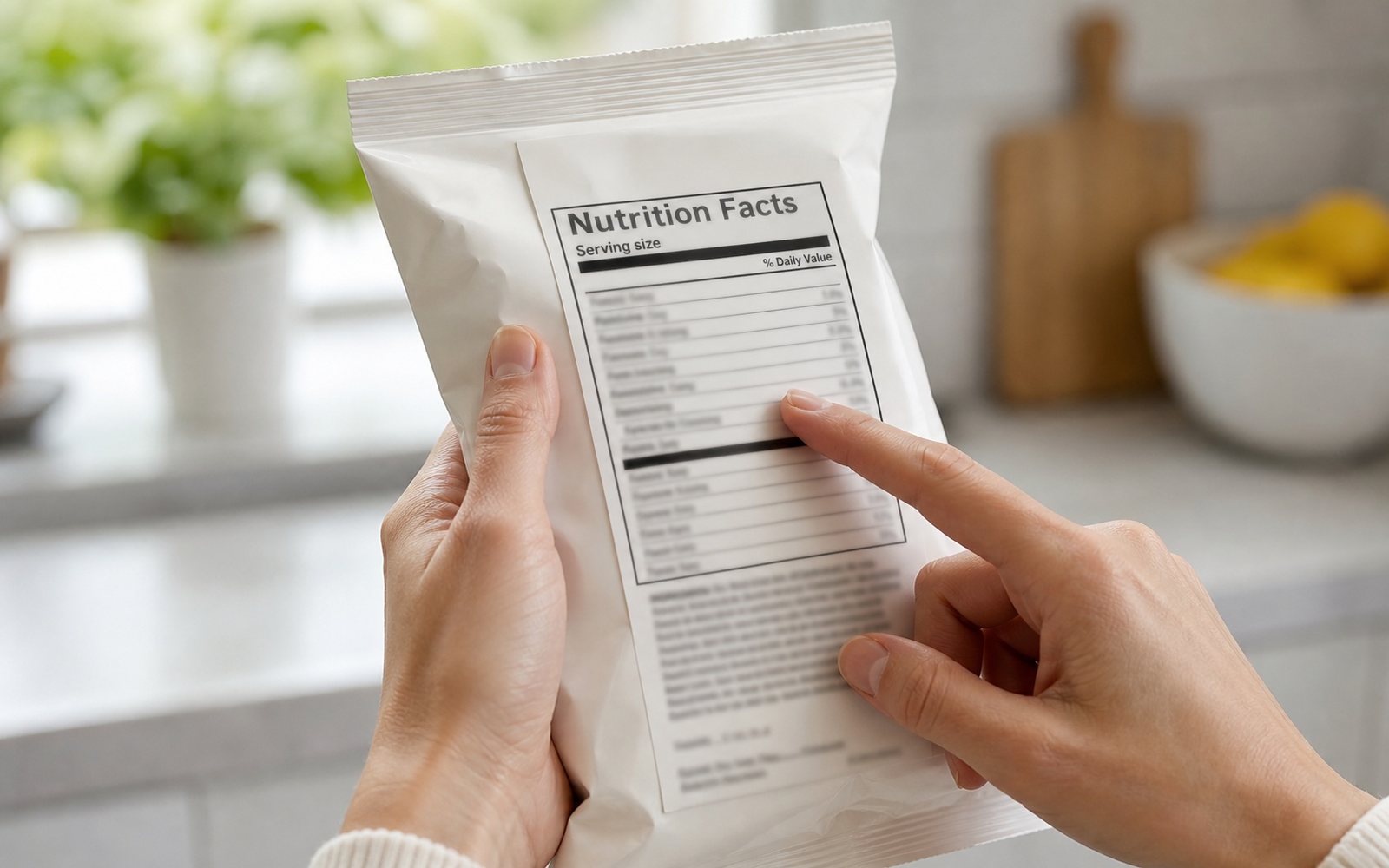
- Read serving size first so every number has a usable basis.
- Compare the two or three nutrients relevant to the food's job.
- Use ingredients and front-label claims as context, not a health verdict.
Pass one: establish the serving basis
Start at serving size and servings per container. Every calorie and nutrient number on the panel is tied to that stated amount. The serving is a standardized reference for comparison, not necessarily the amount your body needs or the portion you must eat. If you usually eat twice the listed serving, roughly twice the listed nutrients are relevant.
Convert the serving into something visible when needed: slices, cups, pieces, or grams. Two cereals can list different serving weights, so comparing only the printed calories can mislead. Use a common amount or compare the portion you realistically eat. This first pass often explains more than scanning the percentages without noticing their basis.
A label number without its serving basis is a measurement without a unit.
Pass two: choose the nutrients that matter here
Do not try to optimize every line. Decide what job the food has. For a bread, fiber and sodium may help comparison; for yogurt, protein, added sugar, and saturated fat may be relevant; for a pre-workout snack, digestible carbohydrate and portion size may matter more. Calories describe energy, not whether the food is automatically good or bad.
Percent Daily Value provides context for how much a nutrient in one serving contributes to a reference daily diet. It is useful for comparison, but it is not personalized to your body, training, or medical needs. A lower sodium option may matter in one plan while a higher-carbohydrate option is useful in another. Choose according to purpose.
- Select two or three nutrients relevant to the product's role.
- Compare like products using the same amount.
- Treat Daily Value as context, not a personal prescription.
Pass three: read ingredients and claims
Ingredients are listed by weight, from greatest to least at the time of formulation. The list helps identify allergens, types of sweetener, whole-grain ingredients, oils, and additives relevant to your preferences. A long list is not automatically unsafe, and a short list does not guarantee nutritional balance. Function and dose matter more than the number of unfamiliar words.
Front-label language is not a complete evaluation. Some nutrient and health claims have defined regulatory conditions, while broader terms and phrases may communicate far less than shoppers assume. Natural, multigrain, made with, and high protein can direct attention to one feature while leaving serving size and the rest of the panel unseen. Turn the package around before paying a premium; the quieter product may fit the job just as well.
The front sells a feature; the panel shows the measurable context.
Use the label, then put the package down
Choose between products with a quick three-pass check and move on. Labels are most valuable for recurring foods, new products, allergies, and specific nutrition goals. They do not need to turn an occasional meal into a research project. Taste, price, access, culture, convenience, and the broader eating pattern are legitimate parts of the decision.
Allergen declarations require careful attention when exposure can be dangerous, and therapeutic diets may require different thresholds than general advice. People managing kidney disease, diabetes medication, celiac disease, severe allergies, or another medical condition should use their clinician's or dietitian's criteria. A general label lesson cannot determine whether a product is safe for an individual diagnosis.
Sources
For severe food allergy, celiac disease, kidney disease, diabetes medication, or another therapeutic diet, follow condition-specific label criteria from your clinician or dietitian. Do not infer allergen safety from front-label claims or from the absence of one highlighted ingredient.