Core Training Beyond Crunches: Resist Movement First
Your trunk does more than bend. Build a simple core plan around resisting extension, rotation, and side-bending while breathing and moving under control.
By Moow Editorial ·
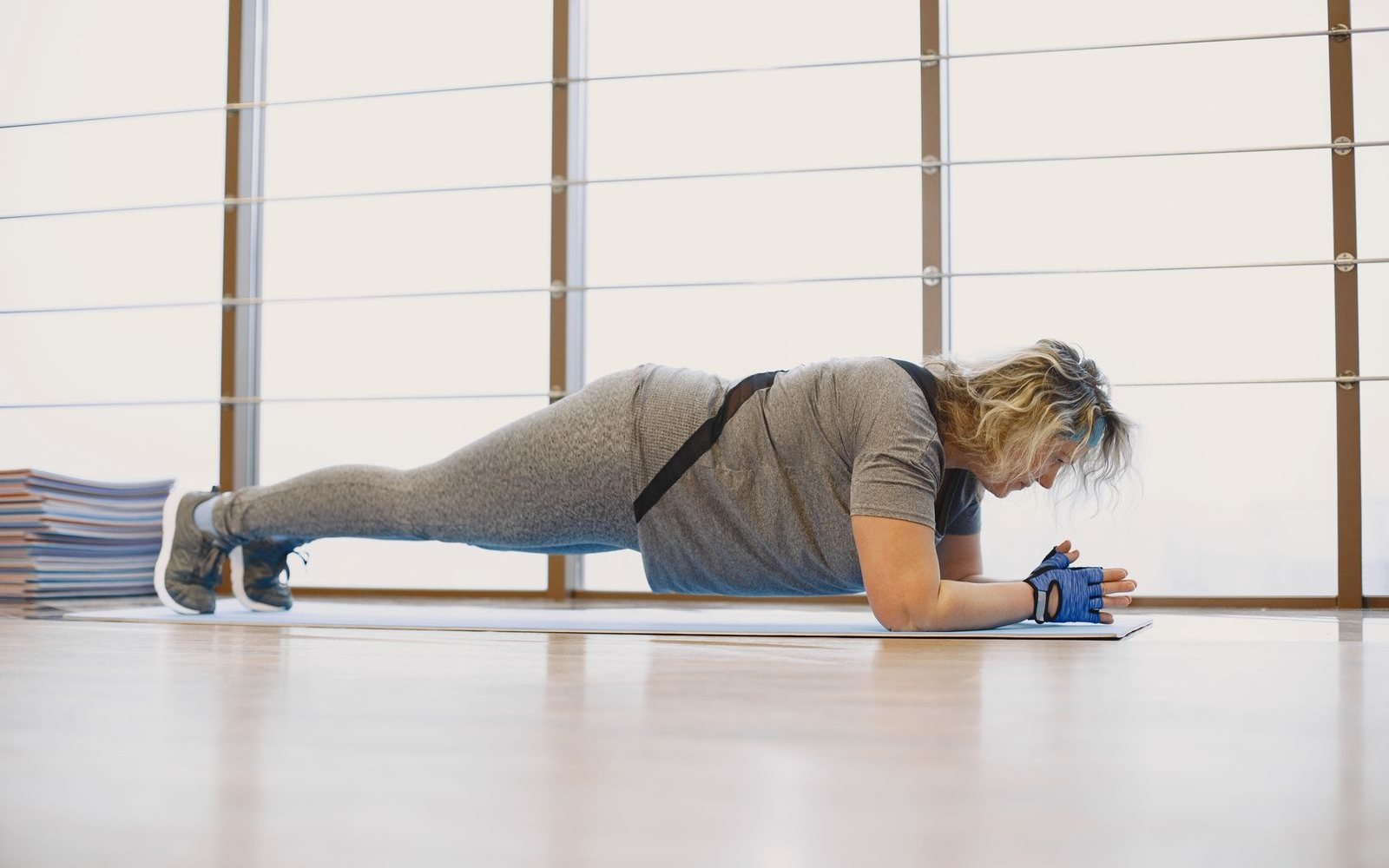
- Train the trunk to resist unwanted extension, rotation, and side-bending.
- Choose versions that allow normal breathing and a repeatable position.
- Progress leverage, load, or duration gradually instead of chasing long, shaky holds.
The core has more than one job
Crunches train trunk flexion, which is a real movement, but they do not represent every demand placed on the torso. During a carry, push-up, row, or squat, the trunk often transfers force while limiting motion that would make the task less efficient. A complete plan can therefore include both moving the trunk and resisting movement under load.
Start with three practical categories: resist extension, resist rotation, and resist side-bending. A front plank or dead bug can challenge extension control. A band press held away from the chest can challenge rotation. A side plank or one-sided carry can challenge lateral control. These labels describe the task; they do not mean the spine is literally motionless.
Use a brace you can breathe through
Set the ribs and pelvis in a position you can reproduce, then create enough abdominal tension to keep the exercise controlled. You should still be able to take measured breaths. Holding the breath for an entire long plank can turn the set into a tolerance contest and may be inappropriate for people whose blood pressure or medical guidance requires different breathing strategies.
End the set when position changes faster than you can correct it. In a plank, that might be the low back sagging or the hips rising to escape the demand. In a carry, it may be leaning toward the weight. Short, repeatable sets with clean breathing provide a better baseline than a record-length hold assembled from several different positions.
Core effort should make the movement steadier—not make breathing disappear.
Progress with leverage before complexity
Increase difficulty by lengthening the lever, moving the load farther from the body, adding a small amount of resistance, or extending a high-quality set slightly. For a dead bug, move one limb before moving opposite arm and leg together. For a plank, first own the shorter version before elevating feet or adding load.
Core training cannot guarantee a pain-free back or correct every lifting issue. It can build capacity for specific tasks, especially when paired with a well-rounded strength and activity plan. If an exercise reproduces radiating pain, numbness, weakness, or symptoms that persist after the session, stop treating it as an ordinary programming problem and seek assessment.
Sources
Stop any core exercise that causes sharp, radiating, or escalating pain, numbness, weakness, dizziness, or pressure symptoms. Pregnancy, recent abdominal surgery, pelvic-floor symptoms, hernia, and some cardiovascular conditions require individualized exercise guidance.