Cold Plunges: A Soreness Tool, Not a Wellness Shortcut
You do not need a cold plunge for recovery. If you still choose one, use a controlled, supervised setting for a specific reason—not broad immunity or fat-loss promises.
By Moow Editorial ·
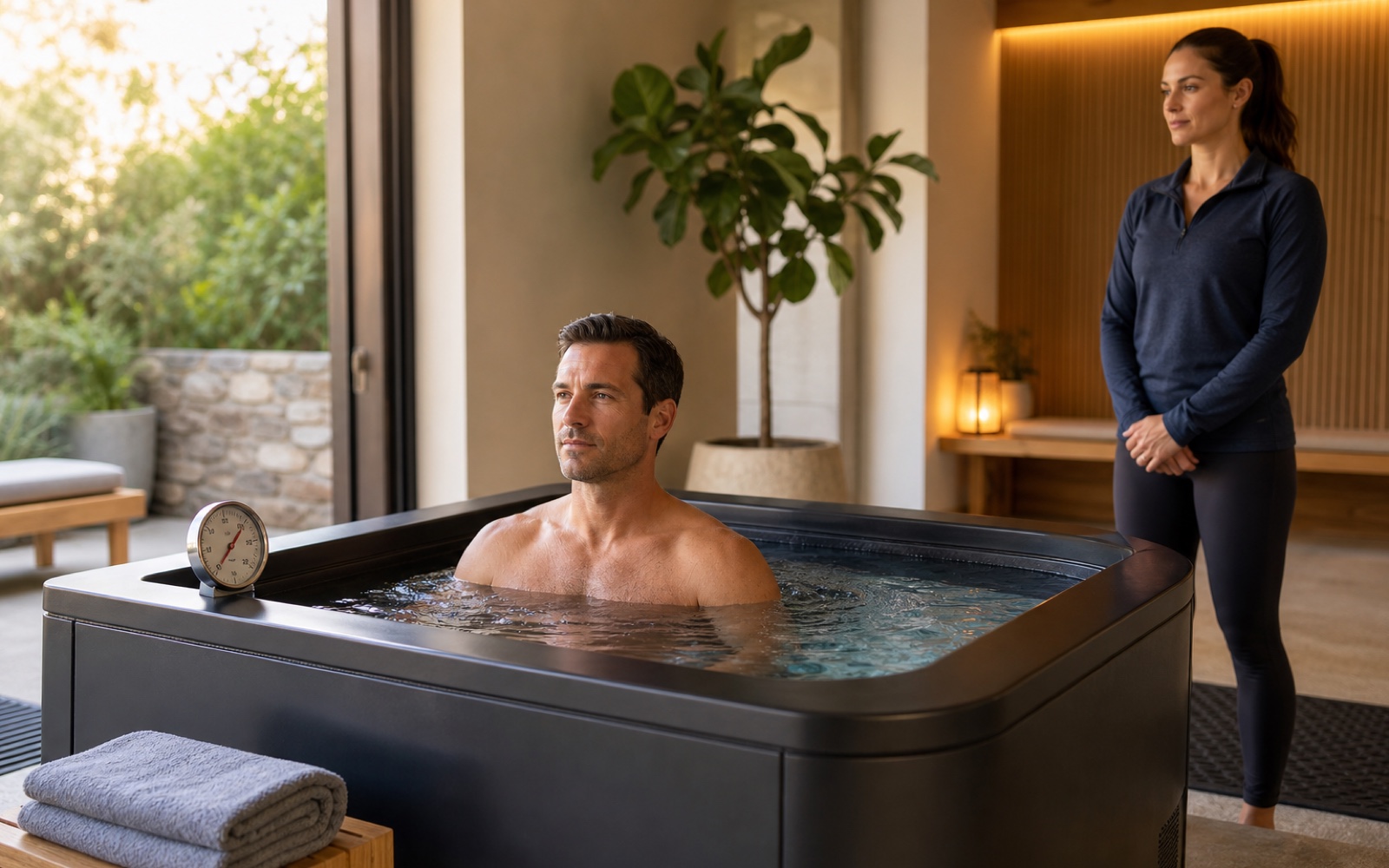
- Cold immersion is optional and its broad wellness claims exceed the evidence.
- Possible short-term recovery effects do not make it ideal after every workout.
- Cold shock and hypothermia make supervision, conservative exposure, and screening essential.
Start with the honest answer: you do not need one
Sleep, adequate food and fluid, appropriate training load, and time are the recovery priorities. A cold plunge may temporarily change soreness or how recovered someone feels after demanding exercise, but it is not required to become fit. Do not buy or use one unless you can name a specific outcome and accept that the effect may be modest.
The decision rule is to skip cold immersion when the goal is vague—“detox,” effortless fat loss, stronger immunity, or general optimization. A 2025 systematic review found a limited and heterogeneous evidence base for health and wellbeing, with small studies, narrow populations, and effects that varied by outcome and timing. Marketing certainty is not research certainty.
If the promised benefit applies to everything, the claim is broader than the evidence.
Match the tool to the training goal
Cold-water immersion is most defensible as an optional short-term recovery strategy when rapid turnaround matters, such as closely scheduled competition. Feeling less sore can be useful, but it does not prove that tissue repaired faster or that performance will improve. A pleasant or invigorating sensation is an experience, not a universal physiological benefit.
Routine immediate cold immersion after every strength session may be a poor default when maximizing long-term muscle adaptation is the priority. The evidence is not a reason to panic about one exposure; it is a reason to use the method selectively. First adjust workload, sleep, and session spacing rather than using cold to make an excessive program tolerable.
- Specific reason rather than a broad wellness promise
- Occasional use instead of an automatic post-workout ritual
- No substitution for sleep, food, fluid, or sensible programming
- A plan to assess whether the claimed benefit actually occurs
Treat cold water as a real physiological stress
Sudden cold exposure can provoke involuntary gasping, rapid breathing, and cardiovascular strain. Use a controlled facility or supervised setup, enter gradually, keep the head and airway clear, and make exiting easy. Never combine immersion with breath-holding challenges, hyperventilation, alcohol, sedating drugs, or a locked or inaccessible tub.
There is no need to chase extreme temperature or duration. Follow a reputable facility's conservative protocol and leave immediately for uncontrolled breathing, chest discomfort, dizziness, confusion, numbness that impairs movement, or panic. Have dry clothing and a safe warming plan ready before entering, and never use open water alone.
Colder and longer are not badges of effectiveness; they are additional exposure.
Know who should not self-experiment
People with cardiovascular or circulation conditions, uncontrolled blood pressure, fainting history, cold-triggered breathing problems, impaired sensation, pregnancy, or relevant medication use should obtain clinical guidance before cold immersion. Recent illness, exhaustion, or being alone also changes the risk-benefit decision.
Stop treating the plunge as recovery if it creates prolonged shivering, sleep disruption, dread, skin injury, or symptoms that outlast the exposure. A recovery practice should make the training week more manageable without introducing a larger safety problem. Choosing a warm shower and an earlier bedtime is not missing a secret advantage.
Sources
Cold immersion can trigger gasping, rapid breathing, cardiovascular strain, hypothermia, and loss of coordination. Never plunge alone or combine it with breath-holding, hyperventilation, alcohol, or sedating drugs. Seek clinical guidance first with cardiovascular, blood-pressure, circulation, respiratory, sensory, pregnancy, or fainting concerns.